
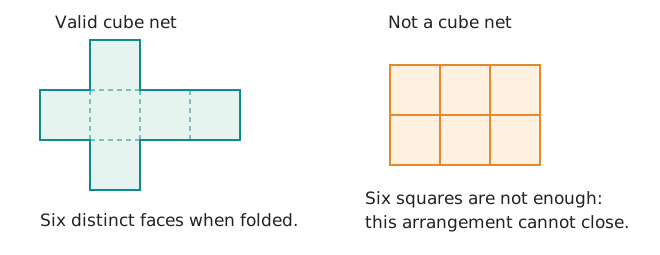
A net unfolds the surface of a solid into a flat arrangement. A valid net folds to close the solid without overlapping faces. A cube needs six equal squares, but not every arrangement of six squares works. For a cuboid, matching edges must have the same length and opposite faces are equal rectangles. A closed cylinder unfolds into two circles and one rectangle whose width is the circumference, not the diameter.
Learning objectives
- Recognise nets that close without overlapping faces.
- Match face dimensions and connect a cylinder net to circumference.
Key ideas
A net unfolds the surface of a solid. Shared edges become folds; matching edges must fit.
A cube has six equal square faces, but six joined squares are not always a valid net.
A cuboid has three pairs of equal opposite rectangles.
A closed cylinder has two circles and a rectangle of height h and width equal to the circumference.
Worked examples
Example 1
List the faces in a net for a 5 cm by 3 cm by 2 cm cuboid.
Each different rectangular face occurs twice.
Answer
Example 2
A cylinder has radius 3 cm and height 5 cm. Find the dimensions of its rectangular net piece.
The wrapped edge matches the circumference of either circular end.
Answer
Question styles to prepare for
Original practice guidance aligned to the specification, not a count of past-paper appearances or a prediction. The AO labels below describe the intended practice focus, not official AQA mark allocations.
AO1 · Methods
Match a net to a solid and label the dimensions of its faces.
AO2 · Reasoning
Explain why a proposed net fails by identifying overlapping faces or mismatched edges.
AO3 · Problem solving
Use dimensions from a solid to complete a net, including the wrapped edge of a cylinder.
When a task asks you to explain, include a mathematical reason. When solving a problem, show how the information becomes a calculation, equation or diagram, then interpret your result.
Avoid this mistake
Check that the net closes without overlap. The wrapped rectangle edge of a cylinder is its circumference, not its diameter.
Try it yourself
Attempt each question before opening its answer.
Check 1: A cuboid measures 5 cm by 3 cm by 2 cm. List the dimensions of all six faces in a net.
Answer: Two 5 by 3 cm faces, two 5 by 2 cm faces and two 3 by 2 cm faces.
Each pair is opposite and equal. Every edge of a face must meet an edge of the same length when folded.
Check 2: A closed cylinder has radius 3 cm and height 5 cm. What are the dimensions of its rectangular net piece?
Answer: 6π cm by 5 cm.
The wrapped edge goes once around a circle: 2πr = 6π cm. The other dimension is the cylinder height, 5 cm.
Explain it in your own words
- Explain why six squares are necessary but not sufficient for a cube net.
- Explain why a cylinder's rectangle uses circumference rather than diameter.
Keep practising
Download the compact topic guide (PDF) · Explore solid shapes · All foundation notes
Specification source
AQA Geometry specification · Assessment objectives. Checked 16 October 2026. Topic references identify related content; these notes do not cover every specification statement.