
A plan looks straight down from above. A front elevation looks straight at the chosen front, and a side elevation looks straight from the chosen side. These are flat views, not perspective sketches. A stack behind another stack can hide some cubes: an elevation records the greatest height along each line of sight, not the sum of the heights.
Learning objectives
- Interpret views of a solid from above, the front and the side.
- Draw elevations of stacks using the correct viewing direction.
Key ideas
Plan means above: keep width and depth. Front elevation keeps width and height.
A side elevation keeps depth and height. Use the stated side, not a perspective sketch.
For stacks, an elevation uses the greatest height along each line of sight; do not add hidden heights.
A plan shows the footprint. It does not by itself give the number of cubes.
Worked examples
Example 1
A cuboid is 5 cm wide, 3 cm deep and 2 cm high. State the dimensions of its three views.
For each view, keep only the two dimensions visible from that direction.
Answer
Example 2
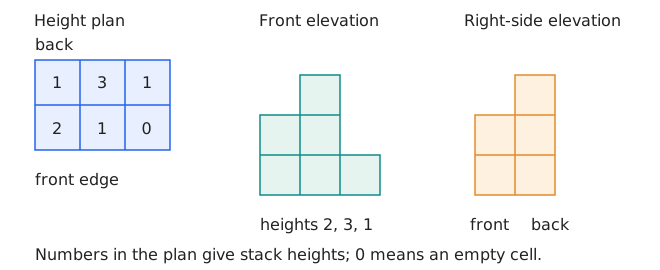
Stack heights are front row 2, 1, 0 and back row 1, 3, 1, both read left to right. Find the front heights and total cubes.
Answer
Question styles to prepare for
Original practice guidance aligned to the specification, not a count of past-paper appearances or a prediction. The AO labels below describe the intended practice focus, not official AQA mark allocations.
AO1 · Methods
Draw or interpret a plan, front elevation and stated side elevation using a square grid.
AO2 · Reasoning
Explain why a hidden stack changes an elevation or why a plan cannot give the total number of cubes.
AO3 · Problem solving
Use several views together to check a proposed solid, identifying any information the views do not determine.
When a task asks you to explain, include a mathematical reason. When solving a problem, show how the information becomes a calculation, equation or diagram, then interpret your result.
Avoid this mistake
Choose the viewing direction first. An elevation records visible height, not the sum of the cubes behind one another.
Try it yourself
Attempt each question before opening its answer.
Check 1: A cuboid is 5 cm wide, 3 cm deep and 2 cm high. Give its plan, front elevation and right-side elevation dimensions.
Answer: Plan: 5 by 3 cm. Front: 5 by 2 cm. Right side: 3 by 2 cm.
The plan keeps width and depth; the front keeps width and height; the side keeps depth and height.
Check 2: A model has two rows of stacks. Front row, left to right: 2, 1, 0 cubes. Back row: 1, 3, 1 cubes. What are the front-elevation heights, and how many cubes are used?
Answer: Front heights: 2, 3, 1. Total cubes: 8.
Take the maximum in each front-to-back column: max(2,1), max(1,3), max(0,1). For the total, add all six stack heights.
Explain it in your own words
- Explain why a plan alone does not show the height of a stack.
- Describe how to choose the front and the right-side viewing directions before drawing.
Keep practising
Download the compact topic guide (PDF) · Explore solid shapes · All foundation notes
Specification source
AQA Geometry specification · Assessment objectives. Checked 16 October 2026. Topic references identify related content; these notes do not cover every specification statement.