
Surface area is the sum of the areas of the exposed surfaces. A net helps count each face once. For a closed cuboid, add three pairs of equal rectangular faces. For an open container, omit the missing face. For joined solids, do not count the faces hidden inside the join. Area uses square units; volume measures the space inside and uses cubic units.
Learning objectives
- Add the exposed areas of a solid using its net.
- Adapt a closed-solid calculation for an open box or a hidden join.
Key ideas
Surface area measures the exposed surfaces; use square units, not cubic units.
For a closed cuboid, count each of the three rectangular face types twice.
For a closed cylinder, add two circles and the wrapped rectangle.
Omit missing faces. For a joined face, remove both touching areas from the sum of the separate solids.
Worked examples
Example 1
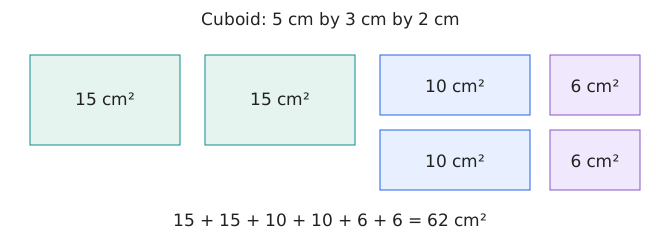
Find the surface area of a closed 5 cm by 3 cm by 2 cm cuboid.
Answer
Example 2
Remove the 5 cm by 3 cm top to make an open box. Find its surface area.
Subtract the missing lid once; keep the base.
Answer
Question styles to prepare for
Original practice guidance aligned to the specification, not a count of past-paper appearances or a prediction. The AO labels below describe the intended practice focus, not official AQA mark allocations.
AO1 · Methods
Add the areas of the exposed faces of a cuboid or the surfaces of a cylinder.
AO2 · Reasoning
Explain a missing face, repeated face or confusion between area and volume in an attempted solution.
AO3 · Problem solving
Find a material area for an open container or joined solids, removing only the missing or hidden surfaces.
When a task asks you to explain, include a mathematical reason. When solving a problem, show how the information becomes a calculation, equation or diagram, then interpret your result.
Avoid this mistake
Count surfaces, not edges or interior space. Do not count an absent lid or a face hidden inside a join.
Try it yourself
Attempt each question before opening its answer.
Check 1: Find the total surface area of a closed cuboid measuring 5 cm by 3 cm by 2 cm.
Answer: 62 cm².
2(5×3 + 5×2 + 3×2) = 2(15 + 10 + 6) = 62. All six faces are included.
Check 2: The same 5 by 3 by 2 cm cuboid is an open-top box, with the 5 by 3 cm face missing. Find its surface area.
Answer: 47 cm².
Remove only the missing lid: 62 - 15 = 47. The base still contributes 15 cm².
Explain it in your own words
- Explain why an open box has a different surface area from a closed box with the same dimensions.
- Explain why both touching faces disappear from the exposed area when two solids are joined.
Keep practising
Download the compact topic guide (PDF) · Explore solid shapes · All foundation notes
Specification source
AQA Geometry specification · Assessment objectives. Checked 16 October 2026. Topic references identify related content; these notes do not cover every specification statement.