
Learning objectives
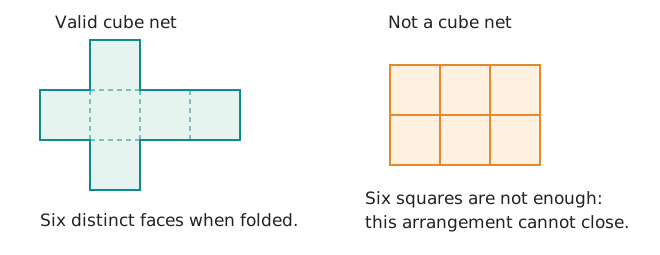
- Recognise nets that close without overlapping faces.
- Match face dimensions and connect a cylinder net to circumference.
Key ideas
A net unfolds the surface of a solid. Shared edges become folds; matching edges must fit.
A cube has six equal square faces, but six joined squares are not always a valid net.
A cuboid has three pairs of equal opposite rectangles.
A closed cylinder has two circles and a rectangle of height h and width equal to the circumference.
Worked examples
Example 1
List the faces in a net for a 5 cm by 3 cm by 2 cm cuboid.
Each different rectangular face occurs twice.
Example 2
A cylinder has radius 3 cm and height 5 cm. Find the dimensions of its rectangular net piece.
The wrapped edge matches the circumference of either circular end.
Watch out
Check that the net closes without overlap. The wrapped rectangle edge of a cylinder is its circumference, not its diameter.