
Learning objectives
- Interpret views of a solid from above, the front and the side.
- Draw elevations of stacks using the correct viewing direction.
Key ideas
Plan means above: keep width and depth. Front elevation keeps width and height.
A side elevation keeps depth and height. Use the stated side, not a perspective sketch.
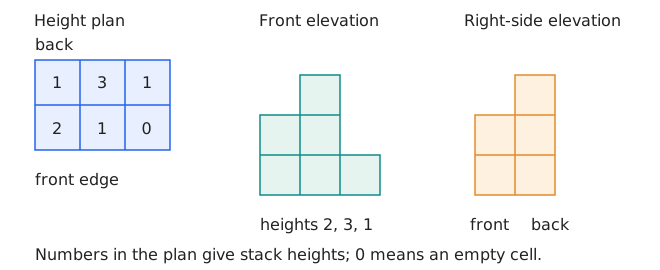
For stacks, an elevation uses the greatest height along each line of sight; do not add hidden heights.
A plan shows the footprint. It does not by itself give the number of cubes.
Worked examples
Example 1
A cuboid is 5 cm wide, 3 cm deep and 2 cm high. State the dimensions of its three views.
For each view, keep only the two dimensions visible from that direction.
Example 2
Stack heights are front row 2, 1, 0 and back row 1, 3, 1, both read left to right. Find the front heights and total cubes.
Watch out
Choose the viewing direction first. An elevation records visible height, not the sum of the cubes behind one another.