
Learning objectives
- Add the exposed areas of a solid using its net.
- Adapt a closed-solid calculation for an open box or a hidden join.
Key ideas
Surface area measures the exposed surfaces; use square units, not cubic units.
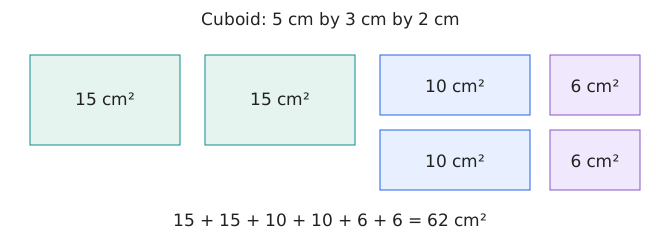
For a closed cuboid, count each of the three rectangular face types twice.
For a closed cylinder, add two circles and the wrapped rectangle.
Omit missing faces. For a joined face, remove both touching areas from the sum of the separate solids.
Worked examples
Example 1
Find the surface area of a closed 5 cm by 3 cm by 2 cm cuboid.
Example 2
Remove the 5 cm by 3 cm top to make an open box. Find its surface area.
Subtract the missing lid once; keep the base.
Watch out
Count surfaces, not edges or interior space. Do not count an absent lid or a face hidden inside a join.